A Listening History of the Piano

PIANOFORTE · 1700 — TODAY · A LISTENING HISTORY

A Listening History of the Piano

Three centuries of piano history, made into a website you can hear.
From four octaves in a Florentine workshop to the eighty-eight keys below your screen—
scroll, play, and hear the instrument change with time.

Headphones recommended · Play with the Z–M and Q–U rows

FLORENCE · THE MEDICI COURT

1700C.

A harpsichord that could play soft and loud

Bartolomeo Cristofori served Grand Prince Ferdinando de’ Medici as keeper of his musical instruments. A harpsichord plucks its strings, so touch alone changes its volume very little. Cristofori set out to build an instrument whose loudness would answer the player’s hands. A Medici inventory dated 1700 records an arpicimbalo, “newly invented by Bartolomeo Cristofori,” with hammers, dampers, two keyboards and a four-octave compass. The name pianoforte would later preserve that promise: soft and loud.

The decisive invention sits beneath the keys: the escapement. The jack throws the hammer toward the string and then moves clear, allowing the hammer to fall back without blocking the string or rebounding against it. A light touch can be quiet; a forceful touch can be loud. Only three Cristofori pianos survive: instruments dated 1720 in New York, 1722 in Rome and 1726 in Leipzig.

Bartolomeo Cristofori’s 1720 piano at The Metropolitan Museum of Art
The oldest surviving piano: Bartolomeo Cristofori, Florence, 1720. The Metropolitan Museum of Art. WIKIMEDIA COMMONS · PUBLIC DOMAIN

GIORNALE DE' LETTERATI D'ITALIA · TOMO V · VENEZIA

1711

The invention enters print

After visiting Florence, the scholar and journalist Scipione Maffei published a detailed account in the Giornale de’ Letterati d’Italia. He called the instrument a gravicembalo col piano, e forte—a harpsichord with soft and loud—and included a diagram of the action. It was the piano’s first widely circulated technical description.

A German translation followed in 1725. The drawing crossed the Alps and reached instrument makers in the German lands, including Gottfried Silbermann in Saxony. Print turned an invention from one Florentine workshop into a European project.

SAXONY · FREIBERG

1730s—1750s

Silbermann, Bach, and a famous bad review

The celebrated organ builder Gottfried Silbermann encountered Cristofori’s design through Maffei’s published account and began building pianofortes in the 1730s. According to Johann Friedrich Agricola, Johann Sebastian Bach objected that the treble was too weak and the action too heavy. Silbermann continued refining the instrument.

In May 1747 Bach visited Frederick II of Prussia at Potsdam, where the king owned several Silbermann pianos. Frederick supplied a theme; Bach improvised on it and later developed the encounter into The Musical Offering. Bach’s position had clearly softened: in 1749 he signed a receipt connected with the sale of a Silbermann piano.

Portrait of Johann Sebastian Bach by Elias Gottlob Haussmann, 1748
Johann Sebastian Bach, painted by Elias Gottlob Haussmann, 1748. WIKIMEDIA COMMONS · PUBLIC DOMAIN

AUGSBURG → VIENNA

1777—1790s

The Viennese action: quick as a whisper

On 17 October 1777, the twenty-one-year-old Wolfgang Amadeus Mozart wrote to his father from Augsburg praising Johann Andreas Stein’s pianofortes: “they are made with an escapement.” However he attacked the keys, Mozart said, the tone remained even and stopped exactly when he wished. Stein’s hammers pivoted directly on the keys in what became known as the Viennese action. Viennese makers—notably Anton Walter—later strengthened and refined the design. Mozart acquired a Walter fortepiano built around 1782 and used it in his Vienna concerts.

The Viennese action paired a light touch with leather-covered hammers and knee levers for the dampers. Its tone was smaller and decayed faster than that of a modern grand, but every articulation spoke clearly—the kind of fleeting, pearled sound for which Mozart’s passagework was conceived.

Wolfgang Amadeus Mozart in a family portrait by Johann Nepomuk della Croce, c. 1780
Wolfgang Amadeus Mozart, painted by Johann Nepomuk della Croce, c. 1780. WIKIMEDIA COMMONS · PUBLIC DOMAIN

LONDON → VIENNA

18181790s—

An English grand for a deaf composer

London makers took another path. In the English grand action, a jack lifts a hammer mounted on a separate rail. The key dip was deeper and the touch heavier, but the result was a fuller, more powerful sound. During the 1790s, John Broadwood & Sons and other London makers pushed the keyboard compass toward six octaves, and composers quickly occupied the new notes.

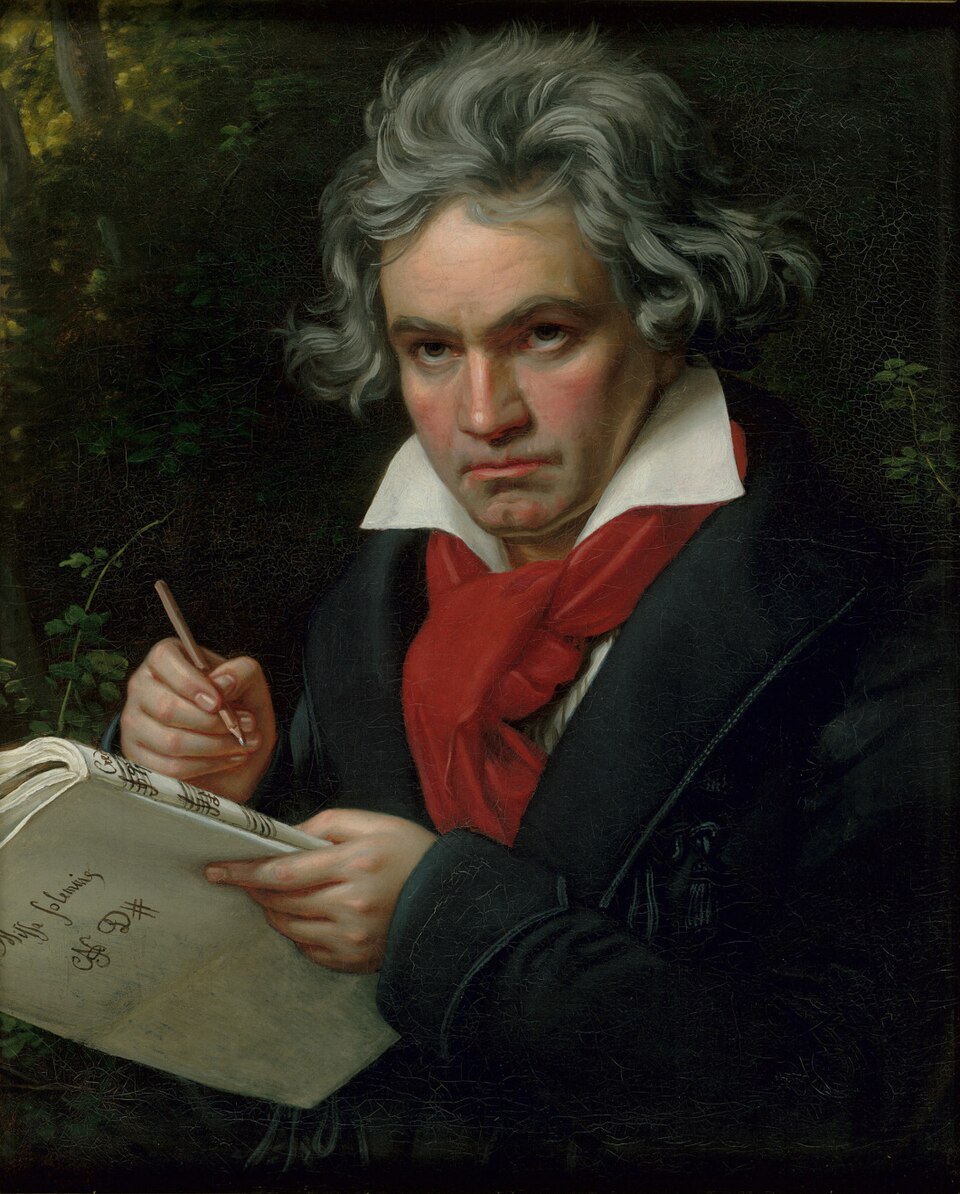
Thomas Broadwood presented Ludwig van Beethoven with a six-octave grand built in 1817. It left London on 27 December and reached Vienna in 1818. Beethoven treasured it until his death. The gift arrived while he was completing the Hammerklavier Sonata, Op. 106—music that seems written for a future piano with a wider compass, greater power and a longer breath.

Portrait of Ludwig van Beethoven by Joseph Karl Stieler, 1820
Ludwig van Beethoven, painted by Joseph Karl Stieler, 1820. WIKIMEDIA COMMONS · PUBLIC DOMAIN

PARIS · THE ÉRARD WORKSHOPS

1821

Double escapement: the same note, repeated faster

Earlier actions imposed a physical limit: to repeat a note, the key had to rise far enough for the mechanism to reset. Sébastien Érard’s double-escapement action, patented in London in 1821 in the name of his nephew Pierre, added a spring-loaded repetition lever. It catches the hammer partway down, so another strike is possible after the key rises only slightly.

Tremolos, repeated notes and fast ornaments could now outrun the old mechanism. Érard’s principle, subsequently refined, remains the basis of the modern grand-piano action.

The repetition lever catches the falling hammer, keeping it ready for a second strike.

INTERACTIVE · I

Inside the piano action

Three mechanisms that changed the instrument. Press a key in the diagram—or use the button—to watch the hammer travel toward the string.

BOSTON · NEW YORK

18591825—

Enter iron: industry rebuilds the piano

More volume required heavier strings and greater tension; wooden framing had reached its limit. In December 1825, the Boston maker Alpheus Babcock patented a one-piece cast-iron frame for a square piano. The plate of a modern concert grand carries roughly twenty tons of string tension.

Steinway & Sons opened in Manhattan in 1853. In 1859, Henry Steinway Jr. patented an overstrung plate: longer bass strings crossed above the tenor strings, allowing a more compact scale and placing the bass bridge nearer the soundboard’s most resonant area. Cast-iron framing, overstringing and the refined double-escapement action became three foundations of the modern grand.

The bass strings cross above the tenor: longer strings within the same case.

INTERACTIVE · II

Three centuries of compass

From four octaves to eighty-eight keys. Hover over an era to reveal its territory; select its bar to hear the lowest and highest notes.

CONCERT HALLS ACROSS EUROPE

1840s

Lisztomania: the piano becomes a spectacle

From 1839 to 1847, Franz Liszt toured Europe with programs built around a single pianist and a single instrument. A London program in 1840 used the new phrase “pianoforte recital.” Liszt sat in profile so the audience could see his hands; broken strings became part of the legend. In 1844 Heinrich Heine named the collective fever Lisztomania.

At the same time, pianos entered middle-class homes as the nineteenth century’s domestic media system: lessons, family songs and four-hand arrangements brought the opera house into the parlor. Before recorded sound became ordinary, the piano was how many households replayed the world’s music.

Portrait photograph of Franz Liszt by Nadar, March 1886
Franz Liszt, photographed by Nadar, March 1886. WIKIMEDIA COMMONS · PUBLIC DOMAIN

INTERACTIVE · III | 1880s—1920s

1900s

A ghost hand on a paper roll

Press play and a perforated roll will perform Scott Joplin’s The Entertainer, published in 1902.
A note sounds at the instant its hole crosses the tracker bar.

Edwin S. Votey developed the Pianola as a cabinet player in 1895 and filed a patent in 1897. Placed in front of an ordinary piano, it used pedals, pneumatics and a perforated paper roll to press the keys. At a 1908 industry convention in Buffalo, manufacturers agreed on an 88-note roll format with nine perforation positions per inch—an early machine-readable music standard. MIDI would later encode many of the same events electronically.

More sophisticated reproducing-piano systems—Welte-Mignon, Duo-Art and Ampico—encoded aspects of dynamics and pedaling as well as pitch and rhythm. Composers and pianists including Debussy, Mahler, Gershwin and Rachmaninoff left rolls behind. Player pianos flourished in the early twentieth century before radio, recorded music and the Depression transformed the market. That perforated paper archive supplies the visual motif running through this site.

A perforated paper music roll mounted in a player piano
A player-piano roll: horizontal position encodes pitch; perforation length contributes to duration. WIKIMEDIA COMMONS

NEW YORK · HARLEM · SEATTLE

1940±30

The twentieth century: improvised and taken apart

Sergei Rachmaninoff carried the late-Romantic piano into records and reproducing rolls. At Harlem rent parties, the instrument acquired another body: the stride pianist’s left hand swung across the keyboard while artists such as James P. Johnson and Art Tatum turned the piano into a rhythm engine.

In 1940, John Cage needed music for Syvilla Fort’s dance Bacchanale, but the performance space could not accommodate a percussion ensemble. He placed bolts, screws, rubber and other materials between the strings: the prepared piano was born. One keyboard could now summon muted thuds, metallic rattles and gamelan-like resonance.

Sergei Rachmaninoff at a Steinway piano, Library of Congress photograph
Sergei Rachmaninoff at a Steinway piano. Library of Congress. WIKIMEDIA COMMONS · PUBLIC DOMAIN

CALIFORNIA · DETROIT RADIO

19651954—

Electric and magnetic: a piano without a soundboard

During the Second World War, Harold Rhodes built compact practice instruments for wounded servicemen, using surplus aircraft aluminum. After the war, the idea evolved into the Rhodes electric piano: felt hammers strike tuned metal tines, and electromagnetic pickups turn their vibration into an electrical signal. There is no soundboard; amplification supplies the scale. The Wurlitzer electronic piano, introduced in 1954, struck tuned reeds instead and produced a drier, sharper attack—famously heard on Ray Charles’s 1959 recording of What’d I Say.

By the end of the 1960s, Miles Davis was placing electric pianos inside dense ensembles. Herbie Hancock, Chick Corea and Joe Zawinul made the Rhodes central to fusion, while soul and funk found their own uses for its bell-like attack and amplified growl.

A hammer strikes the tine; a pickup converts its motion into an electrical signal.

HAMAMATSU · SILICON VALLEY

1983

The digital era: the piano becomes information

At the January 1983 NAMM show, a Sequential Circuits Prophet-600 and a Roland Jupiter-6 gave the first public demonstration of instruments communicating through MIDI. The five-pin connection carried note, velocity and control data across brands. Dave Smith and Roland founder Ikutaro Kakehashi later received a 2013 Technical Grammy for their roles in MIDI’s development. In May 1983 Yamaha released the DX7, using FM synthesis derived from John Chowning’s research at Stanford. Its glassy electric-piano presets became a signature of 1980s pop.

Digital pianos placed sampled or modeled grands behind a keyboard. Yamaha introduced the Disklavier reproducing piano to North America in 1987: sensors capture key, hammer and pedal information, while electromechanical actuators reproduce a performance on an acoustic piano. The perforated roll had become data, but the final event—a hammer striking a real string—still belonged to Cristofori’s world.

Five-pin DIN: notes, velocity and pedal gestures become data.

CODA

Three centuries, eighty-eight keys

From four quiet octaves in a Florentine workshop, through the golden roar of strings held under roughly twenty tons of tension, to data able to cross an ocean—the piano’s history is three centuries of trying to turn touch into song.

The keyboard below now contains every era. Scroll backward and it grows older. Play a note and it answers.